 Rusteau-1D Help
Neural network prediction (Rosetta)
The dialog predicts the van Genuchten parameters θr, θs, α, n and Ks from soil data with the Rosetta pedotransfer functions Schaap et al. (2001); Zhang and Schaap (2017), as the Rosetta Lite dialog of HYDRUS-1D. It opens from Neural network prediction (Rosetta)… on the page Materials & parameters and from Rosetta… next to the soil catalog of the parameter estimation (initial estimates).
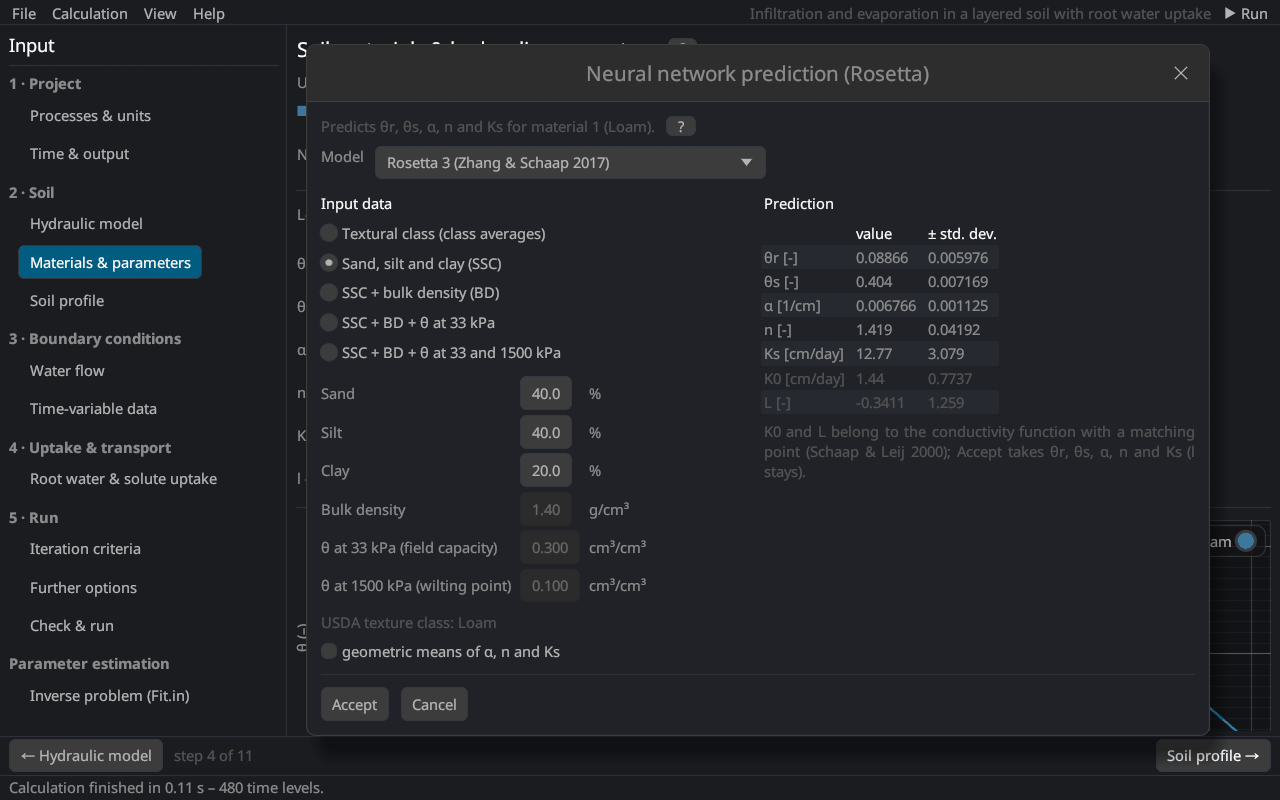
Input data
Rosetta is hierarchical: the more data, the better the prediction.
| Model | Input |
|---|---|
| H1 Textural class | the USDA textural class; gives the average parameters of the class in the Rosetta database |
| H2 SSC | sand, silt and clay [%] (sum 99–101 %) |
| H3 SSC + BD | and the bulk density [g/cm³] (0.5–2) |
| H4 SSC + BD + θ33 | and the water content at 33 kPa (field capacity) |
| H5 SSC + BD + θ33 + θ1500 | and the water content at 1500 kPa (wilting point) |
The USDA texture class of the entered fractions is shown below the inputs.
Models
| Version | Description |
|---|---|
| Rosetta 3 (default) | One network for the retention parameters and Ks, recalibrated with weights from the uncertainty of the fitted retention curves and 1000 bootstrap members Zhang and Schaap (2017). |
| Rosetta 2 | Rosetta 1 with the retention parameters corrected after Schaap et al. (2004). |
| Rosetta 1 | The models of Rosetta Lite in HYDRUS-1D Schaap et al. (2001). |
All are ensembles of neural networks trained on bootstrap samples; the prediction is the ensemble mean, shown with its standard deviation. Geometric means uses 10 to the mean of the logarithms of α, n and Ks instead of the arithmetic means. The network weights are those of the Python package rosetta-soil; the unit tests reproduce its predictions.
Result
The prediction is given in cm and days, with K0 and L of the conductivity function with a matching point Schaap and Leij (2000) for information. Accept writes θr, θs, α, n and Ks, converted to the project's units, into the material (or the initial estimates); l stays.
See also: pedotransfer functions.
Literature cited in this topic
- Schaap, M. G., A. Nemes, and M. Th. van Genuchten (2004). Comparison of models for indirect estimation of water retention and available water in surface soils. Vadose Zone Journal 3(4): 1455–1463. doi:10.2136/vzj2004.1455
- Schaap, M. G., and F. J. Leij (2000). Improved prediction of unsaturated hydraulic conductivity with the Mualem–van Genuchten model. Soil Science Society of America Journal 64(3): 843–851. doi:10.2136/sssaj2000.643843x
- Schaap, M. G., F. J. Leij, and M. Th. van Genuchten (2001). Rosetta: a computer program for estimating soil hydraulic parameters with hierarchical pedotransfer functions. Journal of Hydrology 251(3–4): 163–176. doi:10.1016/S0022-1694(01)00466-8
- USDA-ARS U.S. Salinity Laboratory. rosetta-soil, version 0.3.2: Python implementation of the Rosetta pedotransfer functions (CC0 1.0). https://github.com/usda-ars-ussl/rosetta-soil
- Zhang, Y., and M. G. Schaap (2017). Weighted recalibration of the Rosetta pedotransfer model with improved estimates of hydraulic parameter distributions and summary statistics (Rosetta3). Journal of Hydrology 547: 39–53. doi:10.1016/j.jhydrol.2017.01.004
All sources: References.